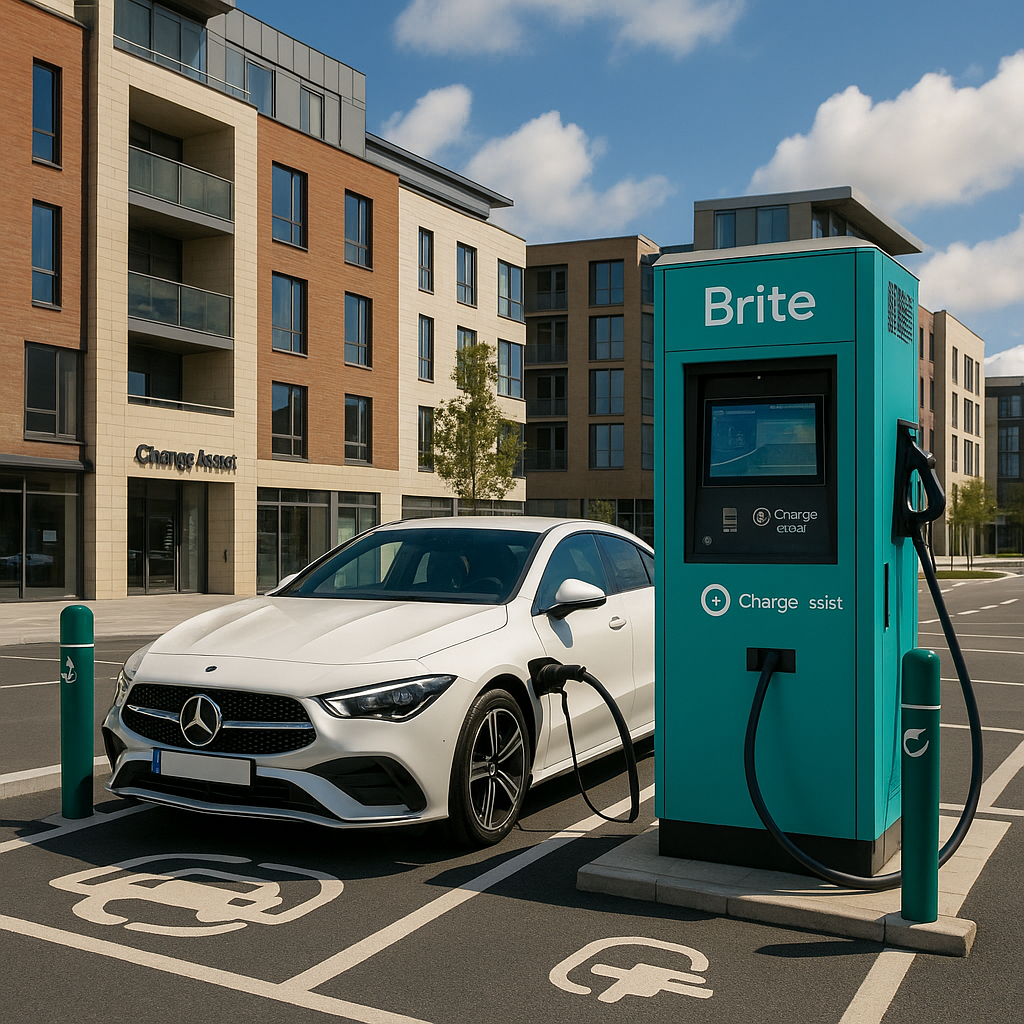
At Brite Ultra Sandy Road you'll see two types of bay — rapid DC and 22 kW AC. Marketing tends to push you towards the fast one. But the AC bays are the cheapest electricity Brite sells, at a flat 50c per kWh, so the right choice comes down to how long you can leave the car.
Here's the real difference, why we have both, and how to choose.
The simple version
- DC (Direct Current) = rapid charging. Up to 300 kW at Brite. Done in 15–30 minutes for most cars. Heavier cable, CCS connector.
- AC (Alternating Current) = slower charging. 22 kW at Brite Sandy Road. Takes 2–8 hours depending on car. Lighter Type 2 cable, easier to handle.
- AC is the cheaper kWh at Brite: a flat €0.50/kWh any time. DC is €0.71 weekday daytime, €0.75 weekend daytime and €0.60 overnight.
If you've got 30 minutes, use DC and pay for the speed. If you've got three hours or more and somewhere to be, AC is both slower and cheaper — on a 40 kWh top-up the AC bay saves €8.40 against the weekday DC rate.
Why we offer both
Rapid DC infrastructure is genuinely expensive — the hardware costs much more per dispenser and the grid connection has to be a lot fatter. AC charging hands the conversion job to your car's onboard charger, which is smaller and simpler, but limited in how much power it can handle. Most EVs cap at 7–11 kW AC. A handful accept up to 22 kW.
The two formats are priced differently because they cost us differently to deliver. A rapid DC bay is expensive hardware on a fat grid connection, and you are partly paying for the speed. An AC bay is simpler and the car does most of the work, so we can pass that on — which is why AC sits at a flat 50c per kWh with no day, weekend or night split.
What AC works well for at Sandy Road
1. Long stops where the car can sit
Going to a hotel in Galway? Staying for dinner at any of the nearby places? AC is your friend. Plug in, walk away, come back to a full car hours later — and at 50c per kWh it is the cheapest way to buy energy from us.
You can leave a car on AC at Sandy Road for up to 10 hours without an overstay fee. After that it's €6/hour.
2. Visiting Galway for the day
Park at Sandy Road on AC while you're in town. Come back to a fully-charged car at the end of the day. Cheaper than rapid DC.
3. Topping up while you run errands
If your car can take 22 kW AC, two hours equals about 44 kWh — a full charge for most family EVs. Same per-kWh price as DC; the difference is you've used the time productively somewhere else.
What DC works well for
1. You're in a hurry
20–30 minutes and back on the road. Don't think about AC.
2. Long road trips
A 20-minute DC top-up keeps you moving. A 4-hour AC charge means you've abandoned your journey.
3. Your car can't take AC fast anyway
If your car's onboard AC charger is rated at 7 kW (some older EVs), you'll only ever charge at 7 kW on AC even on a 22 kW bay. DC bypasses that limit entirely.
4. Cold weather
In cold conditions, rapid DC often includes some battery pre-conditioning from the car, which AC doesn't. In winter, DC can be more useful even for shorter top-ups.
Decision tree
AC or DC at Brite Sandy Road?
- Have less than 60 minutes? → DC
- Have 2+ hours and a car that accepts 11+ kW AC? → AC
- Staying overnight at a Galway hotel? → AC (you save real money)
- On a long road trip and want minimum delay? → DC
- It's after midnight and you're leaving soon? → DC at the €0.60 night rate. If the car is parked until morning anyway, AC at €0.50 is still cheaper.
Check your car's onboard AC charger
Not all EVs can use a 22 kW AC bay at full speed. Your car's manual will tell you its maximum AC charging rate. Common bands:
- 22 kW AC capable — some Renaults, certain Teslas with twin-charger options, certain newer EVs
- 11 kW AC capable — most modern family EVs (Hyundai, Kia, VW Group, Tesla standard, etc.)
- 7.4 kW AC capable — some older or budget EVs
If your car is the 7 kW class, AC at Brite Sandy Road still works — you just charge at 7 kW, so roughly 7 kWh an hour. At 50c per kWh that is about €3.50 an hour of parking turned into range.
What the price gap is actually for
Pricing AC lower than DC is deliberate. It nudges long stops onto the slow bays, which keeps the rapid bays turning over for the people who genuinely need ten minutes and the road. It is better for the grid, better for queueing at the DC bays, and cheaper for you if time is the thing you have most of. The one thing it is not is a reason to sit on a DC bay for four hours.
The bottom line
If you've got the time, AC is both calmer and cheaper at 50c per kWh. If you've got the urgency, DC gets you away in minutes for 60–75c. Pick on how long the car can sit, and the cheaper bay is usually the slow one. Full rates are on the Brite pricing page.
DC and AC at Brite Ultra Sandy Road.
Up to 300 kW DC from 60c per kWh, plus 22 kW AC at a flat 50c. Terryland, Galway, H91 X7PD. Adjacent to Sheils Ford.
See both Galway sites →