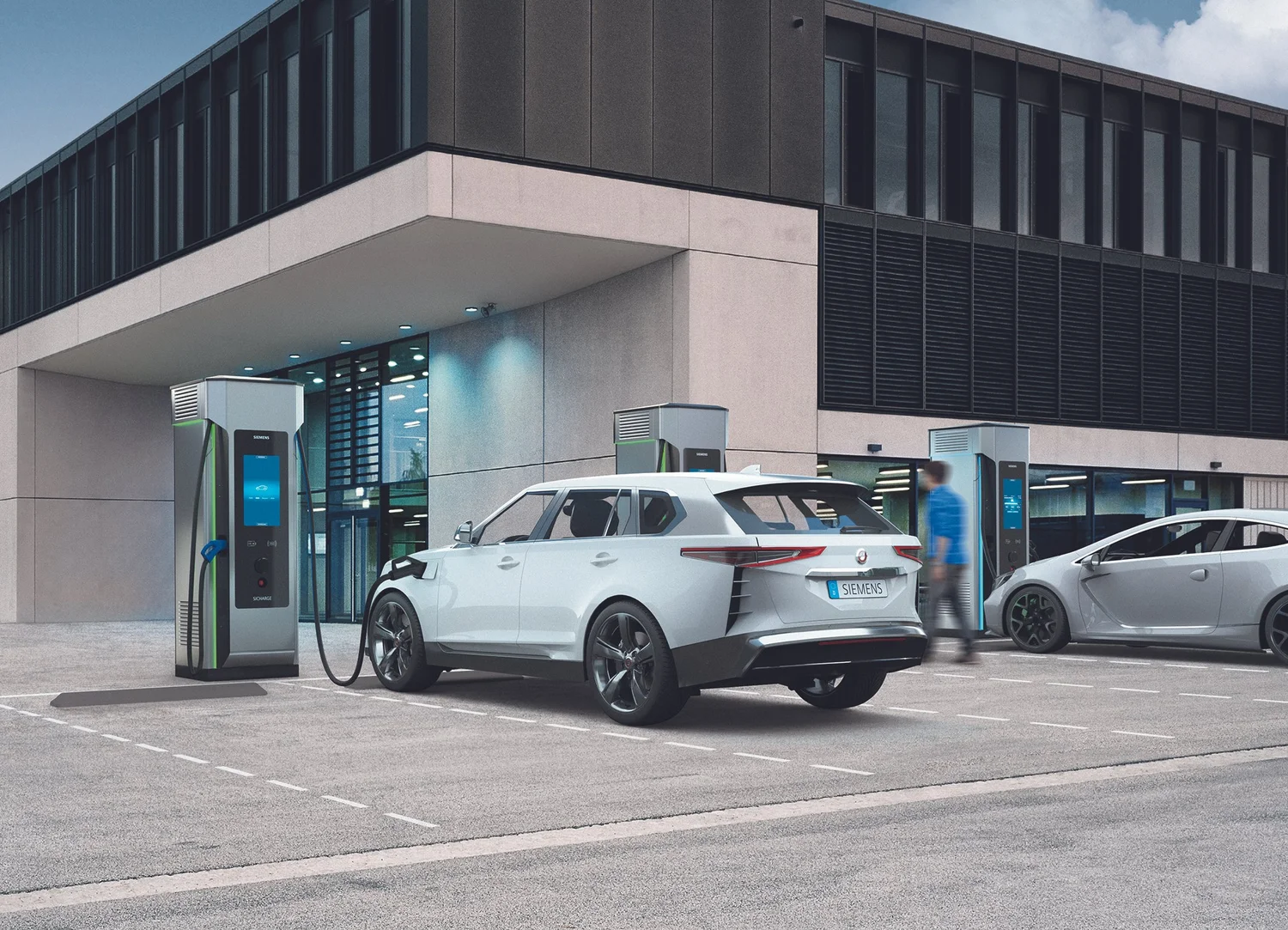
The single most-asked question we get at Brite goes like this: "Your chargers say 300 kW. Why is my car only pulling 80?"
The short answer: the charger isn't the bottleneck. Your car is.
The slightly longer answer is what this article is about. Once you understand what your specific EV is doing on a rapid charger, you stop blaming the network — and you start charging smarter.
The negotiation that happens every session
Every rapid EV charging session is a negotiation between three parties: the charger, your car's battery management system (BMS), and the battery itself. The number you see on the dispenser screen is whatever the slowest of those three is willing to deliver.
The charger says: "I can give you up to 300 kW." Your car's BMS says: "I'll take what's safe for my battery right now." The battery says: "Given my current state of charge and temperature, this is what I can accept." The lowest of the three wins. Always.
What decides your car's ceiling
Two big factors set the upper limit:
1. Battery architecture: 400V vs 800V
Most EVs in Ireland run on a 400V battery system. A small (and growing) group run on 800V. The 800V cars can push roughly double the power through the same connector at the same current — which is the simple physics reason they charge faster.
Cars with 800V architecture in 2026 include: Hyundai Ioniq 5/6, Kia EV6, certain Audi e-tron GT variants, certain Porsche Taycan variants. Most other modern EVs are 400V.
2. Pack capacity and the charging curve
Even a capable battery only takes its peak rate in a specific "sweet spot" of its state of charge — usually somewhere between 10% and 50%. After that, the rate drops off. Most cars charge fast from low percent, then taper after 70–80%.
This is why charging from 5% to 80% takes roughly half the time of charging from 5% to 100%. The last 20% is the slow bit on almost every EV ever made.
"The charger says 300 kW. Your car decides what to take."
— The fundamental rule of rapid EV chargingWhat "doing fine" actually looks like
If you're seeing somewhere in the 60–150 kW range on a modern EV at a rapid charger, you're doing fine. Most family EVs in Ireland sit comfortably in this band. That's a charging rate of roughly 1 to 2.5 kWh delivered every minute, or 5 to 15 km of range per minute. From 20% to 80% in around 20–35 minutes. Coffee-and-a-scone fast.
If you've got an 800V car and you're seeing 180–250 kW, you're in the rare group genuinely using a 300 kW charger for what it's designed for. Welcome to the future.
If you've got a smaller, older or lower-spec EV and you're seeing 40–70 kW, that's also fine — that's what your car is asking for. The charger could give you more. It can only give what's requested.
The five things that slow you down (in order)
1. Your car's BMS
By far the biggest factor. The car decides what to draw, the charger obeys. Nothing you can do at the charger changes this.
2. State of charge
Every battery's fastest charging zone is below 50%. After 80% the rate drops sharply. This is why we recommend planning a stop to leave at 80% rather than waiting for 100%.
3. Battery temperature
A cold battery charges slowly until it warms up. Biggest variable on cold Irish mornings. Pre-conditioning — telling your car you're heading to a rapid charger via the satnav — heats the pack on the way. Most modern EVs do this automatically if you route to a known charger.
4. Charger sharing
Some chargers split available power between bays. At Brite Galway Retail Park, the four dispensers share 199 kW of grid supply. If you're alone there, you can pull up to 300 kW from your dispenser. If three other cars are on it, you'll share. Brite Ultra Sandy Road has a much fatter grid connection (1 MVA total) so sharing is rarely a factor there.
5. The cable on AC chargers
Only relevant for AC sessions. The thinner the cable, the lower the limit. Not an issue on DC.
How to get the most out of a Brite session
Maximising kW on a rapid charge
- Route to the charger in your car's satnav. Triggers pre-conditioning on most modern EVs. Single biggest improver.
- Arrive at 5–15% state of charge. Highest curve, fastest minutes.
- Leave at ~80%. The curve flattens after that. Better to drive 30 km and recharge cheap somewhere else than wait for the last 20%.
- Check the screen. The charger shows actual kW. If it's stuck low, it's usually your car warming up or hitting a curve limit. Wait 5 minutes — it usually climbs.
- Don't leave the car running at idle. Once your session is done, unplug. Brite gives you 75 minutes free after a DC charge, but the next driver appreciates a free bay.
What Brite can and can't speed up
We can't change the rules of physics. Your car's BMS, your battery, your battery temperature — these are all on your side of the cable. What we can do:
- Maintain the hardware so the charger delivers its rated capability when you arrive
- Keep cables short and clean for minimum resistance losses
- Make sure the grid supply is fat enough that you're never sharing unfairly
- Price it fairly so you don't feel cheated when your car asks for 100 kW instead of 300
The bottom line
If you've got an 800V Hyundai/Kia/Porsche/Audi — yes, you'll absolutely use the full speed of a Brite ultra-rapid charger.
If you've got anything else, you're going to see something in the 60–150 kW range most of the time. That's not the network's fault. It's the way EV charging works. The good news: at 80–120 kW you're still adding range faster than any other way of refuelling a car. You just don't think about it that way.
Charge from 5%, stop at 80%, route in your satnav, and you'll get what your car has to give.
Two Galway sites. Up to 300 kW. Up when you arrive.
Brite Ultra Sandy Road (DC + AC bays) and Galway Retail Park (4× DC). Same Siemens SICHARGE hardware.
Open the map →